How do you handle after-hours vehicle pickup at an auto repair shop safely?
Customers love picking up at 7 p.m. Shops love not being there. A clear process for payment, keys, and liability makes both true without an ugly surprise.
Settle payment before the keys leave your control
The non-negotiable rule for after-hours pickup is that the invoice is paid before the customer has access to the vehicle. The simplest approach is to take payment by phone or through an online invoice link while the shop is still open, then release the vehicle once the payment has actually cleared, not once the customer says they sent it. A vehicle released on a promise to pay is a vehicle you may never be paid for, and in many states a shop's lien rights depend on keeping possession of the car. Related: When should a shop text a customer for approval on extra repair work?
Confirm the total with the customer before they pay, including any changes from the original estimate, and send the final invoice in writing. An after-hours pickup is a poor time for a customer to discover a line item they do not recognize, because nobody is there to explain it. Get the questions answered during business hours.
Keep reading: How do you keep customers informed about their car repair status all day?, What is the best way to run a repair shop job board smoothly?, Why do customers get frustrated waiting for auto repair status updates?. See how GarageTrackr helps you auto repair job board with live status for customers.
Choose a key handoff method you can defend
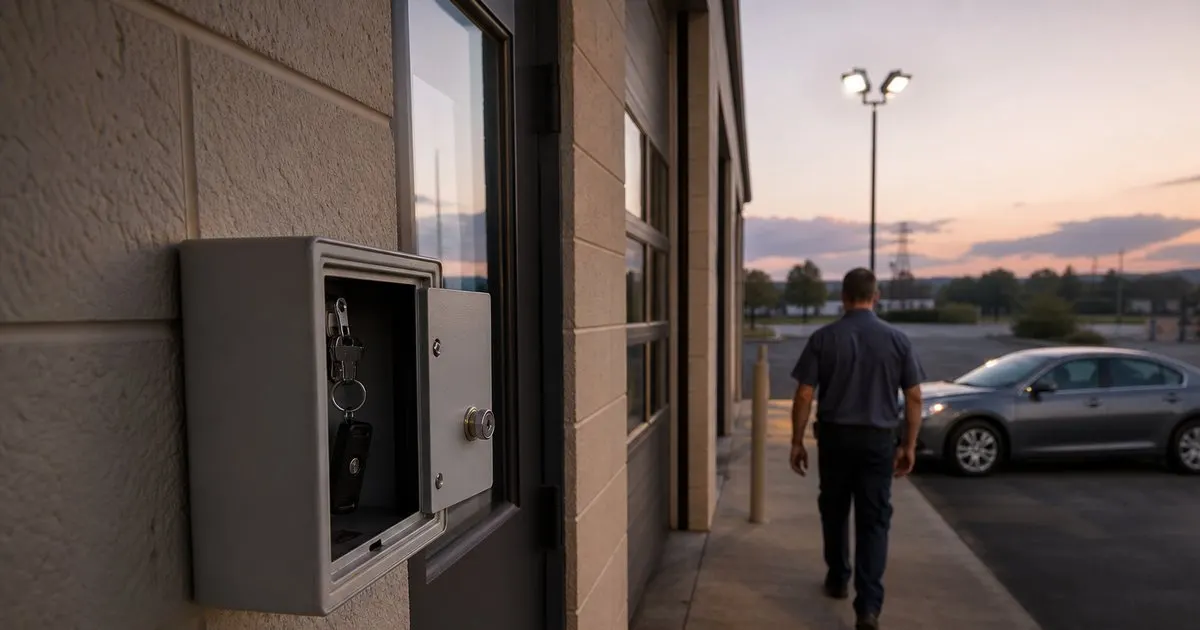
The classic approach is a lockbox with a code that changes per customer, mounted where a camera can see it. Combination lockboxes are inexpensive and work, but the code should be sent only to the phone number on the repair order, and only after payment. Some shops use a keypad cabinet with individual compartments, which scales better if you release several cars a night. What you want to avoid is a single shared code that half the town knows by the end of the year. Related: Why do customers get frustrated waiting for auto repair status updates?
Whatever you use, log the handoff on the job card: the time the code was sent, the number it went to, and the time the vehicle left if you have camera coverage. If a dispute ever arises about a scratch or a missing item, that log and a set of timestamped photos of the vehicle at closing time will be the difference between a conversation and a claim.
Park, photograph, and secure the vehicle deliberately
Before closing, move the vehicle to a well-lit spot near the pickup point, take a walkaround set of photos showing the exterior condition and the odometer, and make sure nothing belonging to the shop, such as a loaner plate, a floor mat, or a diagnostic tool, is still inside. Leave the vehicle locked and keep only the customer's key in the lockbox. Any spare keys or fobs go back to the customer at the next visit or get mailed. Related: How do you keep customers informed about their car repair status all day?
Think about the lot itself. A car left outside overnight in a fenced lot is a different risk than one on a street-facing apron. If your lot is open, consider limiting after-hours pickup to vehicles you can park in view of a camera, and tell customers plainly that the vehicle is at their risk once you have released it. Put that language on the repair order rather than relying on a sign.
Make the customer-facing steps boring and predictable
Customers should know the process before the day of pickup, not learn it in a 6:45 p.m. phone call. When a job is marked ready on the board, the ready notification can include a line offering after-hours pickup and the steps: pay online, receive a code, find the lockbox by the door, and the car is in spot three. Keep the wording identical every time so regulars stop reading it and just do it.
Then close the loop. A quick text the next morning asking whether the car started fine and the pickup went smoothly catches problems while they are small, and it lets the advisor mark the job as truly closed rather than leaving it in ready for three days. Shops that treat after-hours pickup as a real workflow, with the same care as a counter handoff, tend to see customers ask for it more, which frees the counter during the busiest hour of the day. Related: What is the best way to run a repair shop job board smoothly?
- Collect payment and confirm it has cleared before releasing any vehicle after hours.
- Use per-customer lockbox codes sent only to the number on the repair order, and log every handoff.
- Photograph the vehicle at closing time, park it under light and camera, and put the risk language on the repair order.
- Send the same clear pickup instructions every time and follow up the next morning.

Julien Jimenez
Julien Jimenez is an independent software builder based in Paris. He designs, ships, and operates focused SaaS products for small businesses and independent professionals. Read the full author page.
A Job Board Customers Can Follow
Auto repair job board with live status for customers. GarageTrackr is built to help you put this into practice.
Start free trialMore from the GarageTrackr blog
How do you keep customers informed about their car repair status all day?
What is the best way to run a repair shop job board smoothly?
Why do customers get frustrated waiting for auto repair status updates?
Get the GarageTrackr playbook
Practical guides on auto repair software, straight to your inbox as we publish them. No spam, unsubscribe any time.