Why does diagnostic time cause the most customer confusion at a repair shop?
Customers understand paying to fix a car. Paying to find out what is wrong feels different. Here is why diagnosis confuses people and how shops explain it well.
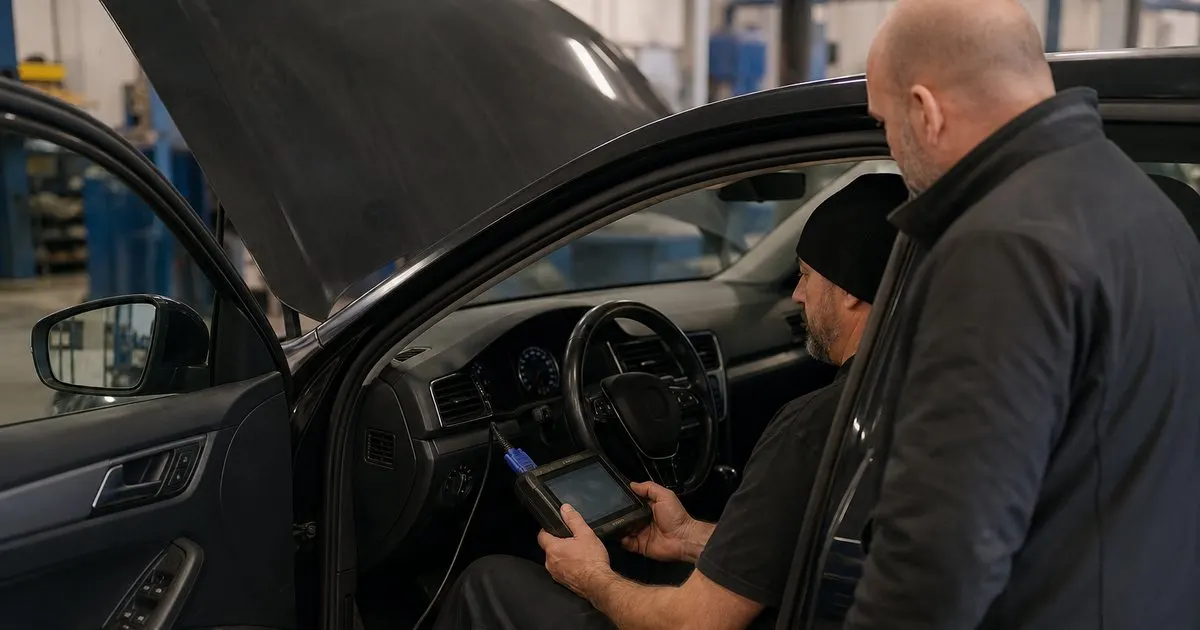
Diagnosis is invisible work with an uncertain end
When a customer approves a brake job, they can picture the result: new pads, new rotors, the car stops. When they approve diagnostic time, they are paying for a process that may end with a request for more time or a report that the fault did not act up. That open-endedness is genuinely uncomfortable, and it is compounded by the fact that most of the work happens on a scan tool, a wiring diagram, or a road test, none of which look like fixing a car to someone in the lobby. Related: When should a shop text a customer for approval on extra repair work?
Shops make it worse when they describe diagnosis as a flat fee for hooking the car up to the computer. Customers then assume the computer produces the answer, and are baffled when the shop calls back asking for two more hours. Describe diagnosis honestly as testing: reading codes is the first step, and the real work is confirming which of several possible causes is the actual one before replacing anything.
Keep reading: How do you keep customers informed about their car repair status all day?, What is the best way to run a repair shop job board smoothly?, Why do customers get frustrated waiting for auto repair status updates?. See how GarageTrackr helps you auto repair job board with live status for customers.
Set expectations in time blocks, not in fees
The clearest way to sell diagnosis is in blocks of time with a checkpoint at the end of each. Ask the customer to approve one hour of testing, and promise that at the end of that hour you will tell them either what you found or what you have ruled out and what the next step would cost. The customer now knows exactly when they will hear from you and that they control the spend at every step. That is far more reassuring than a single number with no explanation of what it buys.
Then honor the checkpoint precisely. If the hour ends with no answer, the call still happens, and it says what was tested, what was eliminated, and what the tech recommends next. Customers rarely object to a second block when they can see the first one produced real progress. What they object to is silence followed by a bigger bill.
Show the evidence, not just the conclusion
A diagnostic result delivered as a bare statement that the car needs a sensor invites doubt, especially if the fix is expensive. A result that includes the reading you got, what it should be, and a photo of the corroded connector builds trust. Most modern job boards let a tech attach photos and short notes to the job card, and the advisor can forward those to the customer with the estimate. The tech does not need to write an essay. Two photos and three sentences usually settle it. Related: What should a service advisor do when a repair needs customer approval fast?
This also protects the shop. When an intermittent fault does not reproduce, showing the customer the test plan and the results is the difference between a customer who feels charged for nothing and one who understands that four causes were ruled out and knows what to watch for. The second customer comes back when the fault gets worse. The first one goes somewhere else.
Keep the status honest while testing is underway
A car in diagnosis should show a status that says diagnosis, with a checkpoint time. Customers who can see testing in progress with an update promised by 11 a.m. on a status page stop calling to ask whether anyone has looked at their car yet. If the status simply reads in progress for four hours, the customer imagines the car sitting in the lot, and the eventual diagnostic charge feels like paying for nothing. Related: How do you keep customers informed about their car repair status all day?
When the diagnosis is complete and the estimate goes out, change the status to needs approval so the customer knows the decision is theirs. Then, if the customer declines the repair, close the diagnostic job cleanly with a written summary of findings. That document is the product they paid for, and handing it over in writing is what makes a diagnostic fee feel fair. Related: Why do customers get frustrated waiting for auto repair status updates?
- Diagnosis confuses customers because the work is invisible and the outcome is uncertain by nature.
- Sell diagnostic time in blocks with a checkpoint call at the end of each block.
- Attach photos, readings, and a short note to the estimate so the conclusion comes with evidence.
- Show a diagnosis status with a checkpoint time, and hand over written findings even if the customer declines the repair.

Julien Jimenez
Julien Jimenez is an independent software builder based in Paris. He designs, ships, and operates focused SaaS products for small businesses and independent professionals. Read the full author page.
A Job Board Customers Can Follow
Auto repair job board with live status for customers. GarageTrackr is built to help you put this into practice.
Start free trialMore from the GarageTrackr blog

How do you keep customers informed about their car repair status all day?
What is the best way to run a repair shop job board smoothly?

Why do customers get frustrated waiting for auto repair status updates?
Get the GarageTrackr playbook
Practical guides on auto repair software, straight to your inbox as we publish them. No spam, unsubscribe any time.